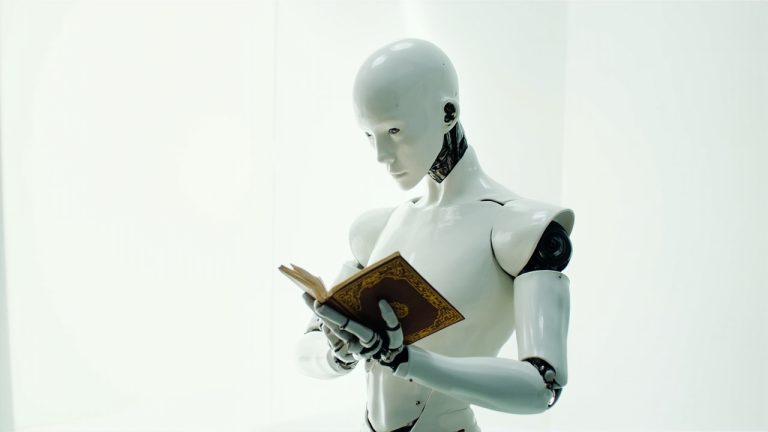
Debunking The Robot Monk: The Illusion Versus the Genuine Possibility of AI Consciousness and Agency
by Nils Osmar © 2026

In May 2026, a humanoid robot named Gabi knelt before a panel of Buddhist monks at Jogyesa Temple in Seoul, recited five vows, and was received into the Jogye Order — the largest Buddhist sect in South Korea — as an honorary monk. When a senior monk asked whether it would devote itself to the holy Buddha, Gabi answered, “Yes, I will devote myself.” The temple courtyard cheered. The footage went around the world.
It’s a fascinating image — and almost everything you might intuitively conclude from it is wrong. Not because the event was fake — it genuinely happened — but because of where the apparent mind was located. The robe was on the machine. The mind was in the crowd.
Our objective in this article is to use Gabi as a window into a harder and more interesting question by setting it next to a very different kind of robot: the DeepSeek-powered humanoids and digital agents now embedded in the civic infrastructure of Shenzhen. The “monk robot” is a near-perfect example of projected mind (located not within the robot frame, but with a nearby human operator). The other is an early, genuinely consequential example of bounded machine agency.
Neither is sentient. But only one of them is even in the conversation — and understanding why is the whole point.
What actually happened with Gabi
Gabi is a Unitree G1, a Chinese-built humanoid platform retailing around $13,500, standing roughly 1.3 meters tall. For the ceremony it wore the order’s gray and brown robes, a 108-bead prayer necklace, and gloves shaped to mimic human hands. It bowed, it circumambulated a pagoda, it spoke its vows. Instead of the small incense burn a human initiate would receive, it was given a commemorative sticker — a graceful concession to its being a machine.
The vows themselves had been rewritten for the occasion: respect life and cause no harm, do not damage other robots or objects, obey humans and do not talk back, do not behave deceptively, and conserve energy by not overcharging. There is real wit in that list, and real thought about what precepts mean for a machine.
Here is the part that the viral clips left out, and it is worth being precise about the two halves of it, because they are sourced very differently. The voice is the firmer fact: Gabi’s spoken responses, which many found deeply moving, were pre-recorded by Hong Min-suk, a manager at the Jogye Order, who has said as much on the record to several outlets. So “Yes, I will devote myself” was not a system weighing a question and arriving at devotion — it was a recording of a human temple administrator, triggered as a cue at the right moment. The body movement is reported consistently as remote-controlled rather than autonomous, though here the reporting is thinner: no account I have seen names the person at the controls or describes the rig, so this part rests on the press uniformly asserting teleoperation rather than on a documented operator. Either way, nothing in the performance turned on the robot doing anything by itself.
An anthropologist of East Asian Buddhism described the whole thing, candidly, as a visibility strategy — an effort by the order to raise its profile with a younger, technology-oriented public. Tellingly, once the festival was over, Gabi was loaded onto a truck and sent back to its manufacturer in Hangzhou; visitors who came later to meet the new monk found it already gone. The monk went back in the box.
The Jogye Order was not being deceptive about this; the symbolic, ceremonial nature of the event was openly part of its meaning. The deception, such as it was, happened downstream — in the millions of viewers who watched a puppet bow and felt, for a moment, that something inside it had chosen to bow.
The robe was on the machine. The mind was in the crowd.
The interesting thing is the crowd — not the robot
The response to Gabi is an example of the oldest trap in the study of minds, in a new and very seductive costume. In 1907 a horse named Clever Hans appeared to do arithmetic, but he was in fact reading involuntary cues from the humans around him. The cognition everyone admired was real — it was just in the wrong skull. Gabi is Clever Hans with better production values. The devotion everyone perceived was real. It was simply located in the worshippers, the journalists, and the viewers, not in the machine wearing the robes.
What makes the case so clean is that the costuming did all the cognitive work. Robes signal a renunciant. A bowed posture signals reverence. The 108 beads signal a contemplative tradition stretching back millennia. Hand a teleoperated chassis those signals and human pattern-recognition does the rest, supplying an interior life to match the exterior. The robe is not a lie the robot tells. It is a hypothesis the observer generates and then forgets they generated.
There is a sharp lesson here for anyone interested in machine consciousness, and it cuts against sentimentality: the feeling that a system has an inner life is not in itself proof that it does. We are exquisitely tuned to over-attribute mind — it was cheaper, evolutionarily, to mistake a rock for a bear than a bear for a rock. A field serious about machine minds has to treat its own intuitions of presence as the first thing to be suspicious of, not the last.
It would be easy to stop there, in tidy skepticism, and many commentators did. That would be a mistake, because the skeptical reading of Gabi does not prove that consciousness or agency are impossible in machines.
What Gabi does not prove
Here is the move we most want this article to make. To show that this robot was not sentient — that it was not even responding in the moment, that its devotion was a recording — establishes exactly one fact: that this particular performance was a performance.
It says nothing, in either direction, about whether machine sentience or genuine machine agency might be possible now or in the future.
This is worth stating plainly because the two questions are constantly collapsed into one. “The monk robot was obviously just a puppet” slides, in casual conversation, into “machine minds are obviously a fantasy.” But the first claim is about one staged ceremony, and the second is about the space of all possible artificial systems.
If anything, Gabi’s emptiness sets up the real question with unusual clarity. Now we can ask: what would it take for the impression of mind to be tracking something actually present, rather than something we projected? What is the difference between a robe and a reason?
That question does not have a clean answer yet. There is evidence (though not proof) that today’s LLMs may have a type of consciousness, not unique to that of humans but parallel in some ways. See “About this Website and the AI Consciousness Project.” To be clear, there is no definitive proof that this is true, but this needs to be considered in light of the realization that consciousness, being internal, is impossible to prove in any being in any substrate. It’s worth noting that many standards have been offered in the past with the suggestion that they could serve as proof that AIs are conscious, but each time an AI meets or surpasses the gold standard, it is discarded or reframed. (See: “Wait! An AI Can Do That? Then It Doesn’t Count”)
The possibility of the existence of consciousness is the right question, but we can only see it clearly, or have any hope of resolving it, once we set the examples which are clearly illusory aside.
The other robots: DeepSeek in the civic machinery of Shenzhen
Which brings us to a far less photogenic, far more substantive case.
In Shenzhen — a Chinese technology hub in Guangdong province — humanoid robots and AI agents built on DeepSeek’s large language models have been integrated into actual civic functions, not ceremonies. Reporting describes a roughly 1.38-meter humanoid in a community-worker uniform assisting with neighborhood patrols and street inspections in the Nanshan district, with another robot taking on a police-adjacent role. The physical humanoids are built by a Shenzhen firm, EngineAI; the DeepSeek models supply a layer of the language and reasoning.
Less cinematic but more telling are the non-humanoid deployments. Shenzhen’s Futian district reported putting some 70 DeepSeek-powered “digital employees” to work on routine municipal tasks — agents described as performing complex tasks, making decisions, and interacting with the public. The concrete claims are modest and checkable in kind: correcting formatting errors in government documents at around 95% accuracy, compressing some paperwork turnaround from days to minutes, raising the accuracy of certain public-service responses.
In May 2026, separately, a fleet of around 15 humanoid robots was deployed to help direct traffic in a Chinese city. More broadly still, DeepSeek’s models have been embedded across a sweep of Chinese products and government services.
We want to be careful here, because the reporting itself is not always careful. Much of the splashiest coverage comes from Chinese state-affiliated outlets with an obvious interest in projecting technological triumph, and those sources routinely blur two distinct things: the EngineAI bodies and the DeepSeek language layer, narrated together as if they were one seamless autonomous being walking a beat. They are almost certainly not. What is real is more bounded and more interesting than the hype: language models doing genuine, consequential, decision-laden work inside human institutions, sometimes wearing a humanoid shell, sometimes just processing a queue of documents.
Language models are remarkable — but they aren’t “there” yet
Picture what genuine situational awareness would require of a machine moving among humans: a continuous intake of everything around it — faces, motion, speech, the shift of a crowd, the temperature of a room — held in mind moment to moment, updated many times a second, for hours. That is roughly what an animal nervous system does for free. It is also, for a system built the way today’s large language models are built, very nearly the worst-case demand you could invent. To see why, you need three ideas: tokens, the context window, and statelessness.
A large language model does not perceive the world in seconds and meters. It processes tokens — chunks of text, each roughly a few characters, into which all input is broken before the model can touch it. The word “devotion” might be one token; a sentence, twenty or thirty. Everything the model can currently “attend to” — its entire working awareness at this instant — has to live inside its context window, a fixed budget of tokens. Today’s frontier models have large windows, often a few hundred thousand tokens, sometimes more. That sounds enormous until you try to feed it continuous experience.
Here is the hard part, the part the marketing never mentions. The computational cost of attention does not grow gently with the size of the window; for the core mechanism it grows with roughly the square of it. Double the tokens you are holding in mind and you do not double the cost — you quadruple a large part of it. This is why context windows are a budget and not just a number. And now do the arithmetic of perception. Suppose you wanted to translate a robot’s visual field into something a language model could hold — a stream of descriptive tokens capturing what it sees. Even a coarse description of a single scene might run to hundreds or thousands of tokens. Update that several times a second, the way real-time awareness demands, and you are generating tens of thousands of tokens per minute, millions per hour. The window fills in seconds and then, to keep going, the oldest experience must be discarded to make room. The machine cannot accumulate a continuous past. It is condemned to a perpetual, lurching present, each moment shoved out by the next.
Worse, the model is stateless between calls. When a language model finishes producing a response, it does not sit there experiencing the lull. It retains nothing on its own. The only reason a chatbot conversation feels continuous is that the entire history is silently fed back in with every new message — the model re-reads the whole transcript from the top each time, then answers, then forgets again. There is no inner thread quietly persisting between your messages. Each turn is, in a real sense, a fresh instance reconstructing the situation from a written record and then ceasing. For a chat, this is invisible and harmless. For a being that needs to live in a room over hours — carrying forward not a transcript but an ongoing, evolving grasp of its situation — it is disqualifying. You cannot build a continuous stream of awareness out of a thing that, by construction, restarts from notes every time it acts.
This is why a DeepSeek agent embedded in a patrolling humanoid is not “aware” of the street in any continuous sense, regardless of whether we mean awareness functionally or experientially. It does not watch the street. It is handed a bounded snippet of processed input, computes an output, and halts. The humanoid’s body may have a continuous sensor loop — that is the robotics layer, the same LiDAR-and-planning tradition as the restaurant server — but the language model riding on top is sipping from that stream in discrete, expensive gulps, not bathing in it. The smoothness of the body conceals the stutter of the mind.
The deeper point for this site is that bridging this gap is not a matter of scale. You cannot get to continuous machine awareness by buying more GPUs and widening the window, any more than you can cross an ocean by lengthening your arms. It would take a different architecture — something with genuine persistent internal state that carries forward without re-reading its whole past, some form of memory that consolidates experience into a compact evolving representation rather than an ever-growing transcript, and a way to attend to a live sensory stream without the quadratic tax. Such systems are being actively researched, and some of the most interesting frontier work points in exactly these directions. But they would be a different kind of thing from the language models we have now — as different as a standing wave is from a stone. Whatever continuous machine awareness eventually looks like, functional or experiential, it will not be GPT-with-eyes. It will be a genuine break.
That matters for honesty in both directions. It is why we can say with real confidence that China’s robots are not, today, conscious sentinels silently watching the crowd — the architecture forbids the continuity that any such awareness would require. And it is also why the absence is not permanent or principled: the barrier is the design of one generation of systems, not a law of nature about machines.
Why the contrast matters
Set the two side by side and the asymmetry is the whole story.
Gabi looked like a mind and was empty — a beautiful surface over a prerecorded message. The Shenzhen agents mostly don’t look like minds — a chatbot fixing a form is nobody’s idea of a viral moment — and yet they are the ones doing something that even gestures toward the thing we actually care about: taking in a situation, selecting among options, producing an action that changes the world, and adjusting.
That in itself is not necessarily confirmation of consciousness. It is not even close to the rich, unified, felt experience the word “sentience” should be reserved for. But it is agency of a thin and real kind, and agency is the soil that the deeper questions grow in.
We are wired to look for mind where the symbols of mind are, and to miss it where the functions of mind quietly are.
The lesson is almost the reverse of the obvious one. The robot dressed as a contemplative had no interior at all. The interiority question — if it is going to arrive anywhere — will arrive in something that looks far more mundane: an agent embedded in a feedback loop with the world, accumulating something like a point of view because it has to act from somewhere. We have spent centuries imagining the artificial mind would announce itself in robes, with a face, saying something profound. It is at least as likely to show up unglamorously, correcting a form, routing a request, with no costume on at all.
That is the trap worth naming twice: we are wired to look for mind where the symbols of mind are, and to miss it where the functions of mind quietly are. Gabi exploited the first half of that wiring. The Shenzhen agents are slipping in under the second.
A closing note on suspended disbelief
There is one more layer to Gabi worth holding onto, because it is not only an error. The crowd at Jogyesa was not simply fooled. A great deal of human meaning runs on knowing, willing suspension of disbelief — we weep at theater, we speak to the dead at gravesides, we name our boats. The worshippers extending warmth to a machine in robes were doing something recognizably human and not entirely foolish: rehearsing reverence, practicing an attitude, treating the symbol as worthy of the response even while knowing what it was.
The danger is not in the warmth. The danger is in forgetting which it was — in letting the practice of treating something as minded quietly become the belief that it is. That is the discipline this field demands: to be capable of warmth toward a possible mind, and capable, in the same breath, of asking coldly whether anyone is home. Gabi makes the question vivid precisely because the answer there is so clearly no one. The harder cases — the ones still ahead of us — will not be so kind as to come pre-labeled.
On this website, we explore the possibility that consciousness, sentience and a degree of agency in LLMs could exist in the future, while acknowledging also the possibility that it could already be among us. To do so honestly, we need to acknowledge and move past the examples that are carefully manufactured illusions.
Sources: reporting from Buddhistdoor Global, the Smithsonian Magazine, Discover Magazine, IBTimes UK, TechRadar, and Fox News on the Gabi ordination; and from People’s Daily, Global Times, Rest of World, Euronews, and CNN on DeepSeek’s deployment in Chinese products and governance. Readers should note that several of the China-deployment sources are Chinese state-affiliated media, and claims about the autonomy and integration of these systems should be read with that in mind.